Monday, 22 July 2019

Ceramic Tiles Market Regional Analysis and Revenue 2019: Top Players - Ceramica Saloni, RAK Ceramics, Porcelanosa Grupo

simpolo-2032188_640.jpg
The global ceramic tiles market was valued at US$ 78.7 Bn in 2015, and is expected to grow at a year-over-year rate of 9.2% to reach US$ 86.0 Bn in 2016. Asia and Europe are the two major markets for ceramic tiles, collectively accounting for 80.6% share of the global market in 2015. Asia Pacific (APAC) is the largest market globally, both in terms of production and consumption.

Demand for ceramic tiles is primarily driven by rising construction activities, economic reforms in developing countries, rapid urbanisation, growing per capita income, population expansion and higher disposable income especially in emerging economies such as China, Brazil and India. However, factors such environmental restrictions and stringent government regulations pertaining to excessive emission of CO2 during ceramic tiles production can hinder the growth of the market.

By application, residential replacement is the largest segment owing to its myriad uses, such as substitutes for marble, paint and other similar products. The residential replacement segment is anticipated to increase at a year-over-year rate of 9.5% in 2016 to reach US$ 85.9 Bn in revenues.
On the basis of type, ceramic floor tiles is the largest segment, accounting for US$ 33.4 Bn worth of demand in 2015. This segment is anticipated to increase at a year-over-year growth of 9.5% to reach US$ 36.6 Bn in revenues in 2016.


On the basis of regional segmentation the global ceramic tiles market is segmented into Asia Pacific, Europe, North America & Latin America and rest of world (ROW).
Demand for ceramic tiles used for residential replacement has increased as these can be used as substitutes for paints, marble and other similar products. Growth of the segment is likely to be hampered by governmental regulations pertaining to exhaust gases emitted during the production process of ceramic tiles. Production of ceramic tiles requires high temperatures usually in the range of 2000-25000 C. Large quantity of fuels is required to create such high temperatures. This leads significant emission of CO2 in the atmosphere.
Various companies have invested significantly in the development of new environment-friendly production processes due to increasing number of stringent government regulations pertaining to greenhouse gas emissions. In the recent past, industry participants have been focusing on capacity expansions to increase their production capacities. Key market players operating in the ceramic tiles market include RAK Ceramics, China Ceramics, Mohawk Industries, Ceramica Saloni, Kajaria Ceramics and Porcelanosa Grupo. Expansion through various business partnerships and product portfolio globally, focusing on sustainability, aiming at growth by new product development and strategic acquisitions will remain the key strategies of the ceramic tiles manufacturers worldwide during the forecast period.


In recent years, the global ceramic tiles landscape is witnessing increased production offerings and capacity expansion by various market participants, including China Ceramics, Ceramica Saloni, RAK Ceramics, Porcelanosa Grupo, Mohawk Industries and Kajaria Ceramics. The revival of the global economy has been bolstered the global housing sector, which in turn, has led to growth in the global ceramic tiles market.
Long-term Outlook: The global ceramic tiles market is anticipated to increase at a CAGR of 9.3% during the forecast period to reach US$ 112.3 Bn in revenues by 2019 end. Asia Pacific will remain the most lucrative region during the forecast period, whereas residential replacement application segment will continue to account for the highest demand.

Empty Capsules Market 2026 - Trends, Business Strategies and Opportunities with Key Players Analysis & Forecast by FMI

drug-1674890_640
The global revenue of empty capsules market is likely to approach a value of US$ 3 Bn by the end of 2026, as indicated by a recent study conducted on the empty capsules market by Future Market Insights. According to an intelligence report released by FMI, the global market for empty capsules will possibly expand at an impressive CAGR of 7.3% over 2016-2026.

“The global empty capsules market will witness robust growth over the projection period, 2016-2026. While this growth is supposed to be prominently driven by escalating demand for both vegetarian-based and Halal certified empty capsules, FMI estimates strong boost to empty capsules market growth by a broadening application base in pharmaceuticals, cosmetics, and nutraceutical companies, as well as in CROs, i.e. clinical research organizations,” states an expert research analyst at FMI.

Vegetarian capsules, one of the latest industry innovations, are foreseen to gradually replace the conventional gelatin-based capsules. FMI concludes that despite the high price point, the demand for vegetarian-based capsules is constantly on the rise, predominantly driven by immense popularity and success of the nutraceutical and pharmaceutical domains since the past decade. Manufacturers operating in the global empty capsules marketplace with sizable revenue shares are already shifting to the production of vegetarian capsules, in addition to expanding their existing production capacity.


There are multiple complications associated with the use of gelatin in empty capsules making, such the probability of drug-gelatin interaction and restricted formulation possibilities during R&D. In an effort to avoid such complexities, a majority of manufacturers are increasingly interested in manufacturing vegetarian-based capsules, which is presumed to boost the demand for vegetarian capsules in the empty capsules market over the forecast period.
Several empty capsule manufacturers are currently considering including an expanded range of vegetarian products in their existing product offering, including gastric acid resistance, enteric coated, fast disintegration, and customized clinical trial capsules to increase their revenue base. On the flipside, a considerably larger chunk of companies is still exclusively preferring hard gelatin-based capsules. FMI expects such players in the empty capsules market to encounter robust incremental growth opportunity, only if they prefer to include vegetarian-based, plant-based, or marine gelatin capsules in their product portfolio. 

On the other side, the Middle Eastern regional market for empty capsules is witnessing an elevating trend of Halal certified capsules, compelling manufacturers in MEA to shift to making Halal certified products for leveraging opportunities. Future Market Insights projects that the neat future will witness the formation of a structured regulatory framework to encourage and mandate the development and introduction of clean label empty capsules.
Moreover, growing consumer inclination towards purchasing the products that have only natural colorants is creating a new wave of trend in the empty capsules market. Top empty capsule manufacturers are thus focusing on designing the naturally colored capsules rather than those that possess artificial colorants. Plants and vegetables are primarily being used by manufacturers for the development of naturally-sourced colorants used in the manufacturing of empty capsules.


As the near future is foreseen to be witnessing an expanding portfolio of vegetarian capsules, it is most likely that the global empty capsules market will experience emerging

Friday, 19 July 2019

Clinical Trials Market Emerging Growth Analysis, Future Demand and Business Opportunities 2029

Capture
A new study of Future Market Insights (FMI) estimates the global spending on clinical trials in 2019 at ~US$ 90 Bn, recording a ~4% Y-o-Y over 2018. The healthcare sector is closing in on a new era of clinical trials, which are more engaged with patients, streamlined and connected. With development costs reaching record highs and patents approaching cliffs, companies are strengthening their R&D efforts to keep pace with change. Medical device and pharma giants are already eyeing better approaches for clinical trials, implementing a combination of their current systems and better technologies to ebb challenges in critical areas – orphan drugs and rare diseases.

“The ubiquity digital technologies is evidently growing, as these (including but not limited to ingestible devices, sensors, and wearable health monitors) hold the potential to disrupt the aspects of clinical trials. Digital technologies are revolutionizing the antiquated process of new drug development, even as optimizing the way health data is collected, measured, and assessed”.

According to the study, the clinical trials landscape is witnessing a paradigm shift toward patient centricity, in a bid to incorporate perspective of patients during the clinical trial design. Clinical trial sponsors have aligned their methods with the voice of patients, by launching communication channels during the study’s execution. Key enterprises are adopting unconventional approaches by implementing site-centric method, using operational support systems and technology for bringing studies to the trial-naïve physicians.


Industry Sponsors Account for Majority Clinical Trial Spending
The most remarkable advances in medicine are realized from sponsorships of companies for clinical trials, in the anticipation of turning a profit. A notable percentage of clinical trials being conducted to support approval of vaccines, devices, or drugs, and track their safety, have been industry-sponsored in recent years.
The study estimates industry-sponsored clinical trials to account for ~60% of overall spending in 2019, and in the foreseeable future. Recent studies state that industry-sponsored trials yield positive results compared to academic-run trials, which also account for a significant share of clinical trial spending.

According to FMI, sponsors, such as academic institutes, research institutes and medical centers, are estimated to account for ~30% clinical trial spending in 2019. As the imperativeness of evidence-based therapies continue to be progressively emphasized, most of the randomized clinical trials are driven by the ability of developing profitable new therapies. Guidelines recommended by regulatory bodies for clinical trial enrichment, and risk-based monitoring are likely to lay the groundwork for more targeted approach toward cost-intensive clinical trials.

The study opines that North America and Europe will continue to lead the clinical trials landscape, collectively accounting for ~80% of global spending. These regions present a standardized and favorable environment for the clinical trials landscape, in light of their economic vigor that enables them to benefit from most of the technology disruptions prior to other nations. Pharmaceutical and medical device giants in these two regions are adopting AI for disrupting every stage of the clinical trial, which range from linking studies to eligible patients, to data collection and adherence.


According to the study, opportunities abound for conducting clinical trials in developing economies, such as in East Asia and South Asia, owing to the access to huge patient pool. Sponsors are likely to realize greater success in these regions as low government healthcare budgets represent cost-effective methods of providing patients with access to innovative therapies. Additionally, conducting clinical trials in these regions comes with other broader advantages, including pragmatic & efficient regulatory pathway, and tax incentives for conducting the trials.
The study offers a long-term forecast of the clinical trials landscape for the period between 2019 and 2029. The clinical trials landscape is projected to record a 4.5% CAGR through 2029.

Thursday, 18 July 2019

Nucleic Acid Isolation and Purification Market Demand, Supply Growth, Industry Insights, Top Trends, Drivers, and Forecast 2019 to 2029

Future Market Insights (FMI), in its latest publication, outlines the future trajectory of the global nucleic acid isolation and purification market through 2029. According to the report, worldwide sales of nucleic acid isolation and purification kits were valued at ~US$ 830 million in 2018, and are estimated to register a Y-o-Y growth of ~4% in 2019. As the consistency and reliability of molecular diagnostic results relies heavily on the quality of genetic material i.e. DNA and RNA, manufacturers are focusing on offering high-quality products, ensuring improved yield and purity.
With growing need to understand and characterize microbial diversity, including that associated with human body, governments as well as private companies are increasingly investing in life science projects, thereby creating a greater demand for nucleic acid isolation and purification. While the high cost challenge persists, shortage of skilled professionals in healthcare and biopharma industries remain the longstanding challenges.
“Rapid and efficient methods or products to extract genomic RNA and DNA from virtually any biological sample have been growing in demand to ensure the success of downstream applications in molecular biology. With growing research on detection of tumor specific changes, FMI study finds that nucleic acid isolation and purification market vendors are exploring new technologies to facilitate ease-of-use and minimize user-error of their products.”


Future market Insights' study reveals that the nucleic acid isolation and purification market is likely to expand at a CAGR of ~5% during the period 2019-2029. One of the key influencing factors is manufacturers' focus to direct their investments towards advanced technologies such as magnetic-bead or bead-beating technology, to align with end users' demand for an effective system for extraction of high-quality starting material and efficient inhibitor removal. The unique challenges for extracting and purifying nucleic acid from different organisms and tissue types, have also brought more focus on customized systems and solutions.

Advances in Microbiome Research to Dictate Manufacturers’ Growth Strategies
In comparison with RNA isolation kits, manufacturers continue to increase innovations and production of DNA isolation kits, as the category is expected to account for larger share in the market during the forecast period. As per the study, lucrative opportunities are identified in increasing application scope of DNA isolation and purification kits in various academic research institutes, contract research organizations, and biotechnologies companies to not only successfully extract the DNA but also to minimize the presence of contaminants and prevent nucleic acid degradation during preparation. As genomic and microbiome research advances, manufacturers are working on automating the nucleic acid isolation and purifications kits to recover DNA and RNA from the toughest samples used in microbiome work such as soil and stool samples.


Growth prospects of the nucleic acid isolation and purification market, as the study opines, are relatively high in developed countries of North America and Europe. Hefty investments in R&D on molecular biology and precision medicines over gradual increase in the prevalence of cancer, genetic disorders, and complex diseases are likely to influence the manufacturers to enhance their production capabilities.
Tapping into opportunities in China and Japan for acquiring local players and increasing manufacturing facilities will provide the added advantage to gain a new customer base. As innovations zoom in, a number of market players are working on offering products that are free of toxic organic solvents and enable cost-effective method to extract and purify PCR-ready DNA or RT-PCR-ready RNA from numerous samples.
The report also offers an incisive outlook on the competitive landscape of nucleic acid isolation and purification market. As per the study, extensive M&A activities and new launches remain the key focus areas of the market players. In addition, they are emphasizing on strengthening outsourcing and solutions through strategic collaborations.

Fish Protein Concentrate Market Share, Development by Companies Outlook, Growth Prospects and Key Opportunities by 2029

fish protin
Future Market Insights (FMI), in its new research study, underlines the key elements shaping growth of fish protein concentrate market for the assessment period of 2019-2029. According to the research study, sales of fish protein concentrate touched ~ 57,466 MT in 2018, and are likely to grow by 5.5% YOY in 2019. As fish protein concentrate goes up the popularity scale as a viable ingredient for value-addition, market players are looking for ways to enable a production ramp-up in a bid to bridge the supply-demand gap.
According to the research study, demand for animal-sourced protein is seeing a quantum leap, as animal proteins have gotten positive reviews in recent years from a nutritional standpoint. Consumers are now showing much more confidence in animal proteins, which is a distinct move away from the time when ‘plant-sourced’ was synonymous with ‘healthy’. Such trends are signaling the influx of promising opportunities for the fish protein concentrate market in 2019 and beyond, finds the report.


“The leading participants in the market could also center on devising persuasiveand influential marketing strategies by identifying the regional patterns of animal-sourced proteins. Powerful advertisements are no less than a harpoon for capturing the ideal customer targets, which, in turn, will help the manufacturers to hit the right the right spot.”

The research study finds that growth of brands in the fish protein concentrate market will be largely defined by the bespoke formulations they bring into the table for their customers. In addition, governments across various countries- the U.S. Sweden, Canada, and Japan to name a few- are centering on promoting fish protein concentrate as a ‘must-have’ ingredient. This, in turn, is poised to create a new pool of opportunities for the market players to tap into.

According to the report, type C will clearly lead the pack by a large margin, followed by Type B and Type A. Since the type C is manufactured under utmost hygienic conditions, it has been and, will continue to be perceived of being ideal for consumption. In addition, prices of type C are relatively reasonable as compared to type B and A, which further underpins the overall growth in consumption of type C through 2029. The report further opines that consumers will continue to show marked preferences for powder forms over liquid ones, owing to their larger shelf-life and ‘easy-to-transport’ benefits. 

Opportunities galore for the market players of fish protein concentrate, as the food & beverage producers worldwide are embracing fish protein concentrate for ‘value-addition’ purposes. As the transition towards nutritional diet firms up, food and beverage producers are leaning on fish protein concentrate to increase their product integrity. Use of fish protein concentrate in cosmetic and personal care industry is likely to pick pace through 2029, as the demand for chemical-laden cosmetic and personal products is seeing a drastic collapse.


Manufacturers to Extensively Focus on R&D Activities, Cogent Packaging Remains a Priority
Manufacturers will continue pouring investments in R&D activities, as product innovations in such a turbulent market space certainly pays off. As the leading companies face intense competition from regional players, their focus on research and development will continue to get strong and profound. Manufacturers are also focusing on offering wholesome and consistently available fish protein concentrate, so that their products clearly stand out amid the global market shelves.
Packaging continues to be a key interactive tool for the manufacturers to convey their brand values and establish meaningful relationships with their end user bases. The market players are placing ‘transparency in packaging’ at the top of all their marketing priorities, as product transparency plays a key role in turning consumer decisions into the brands’ favour.

Wednesday, 17 July 2019

Fluoropolymer Market Research, Insight, Forecast, Outlook & Analysis by Future Market Insights Report

chemical.JPG
Fluoropolymer is a fluorinated polymer that has multiple strong carbon-fluorine bonds.  Fluoropolymers possess unmatchable combination of chemical resistant and mechanical and electrical insulation properties. Due to these properties, fluoropolymers are widely being used in various automotive and electrical & electronics applications. Fluoropolymers are very popular in industrial processing industries due to their chemical and oil resistant properties.  In terms of revenue, the global fluoropolymer market was valued at US$ 6,403.4 Mn in 2014 and is projected to account for US$ 11,472.6 Mn by the end of year 2025. In terms of volume, the global fluoropolymer market stood at 299.9 thousand tonnes and is anticipated to reach 478.2 thousand tonnes by 2025.
On the basis of product type, the global fluoropolymer market has been segmented into polytetrafluoroethylene (PTFE), polyvinyl fluoride (PVF), polychlorotrifluoroethylene (PCTFE), polyvinylidene difluoride (PVDF), fluorinated ethylene propylene (FEP), perfluoroalkoxy polymer (PFA) and others. Polytetrafluoroethylene (PTFE) segment accounted for the largest market share of over 41% of the global value for fluoropolymers in 2014. The segment is anticipated to expand with a significant CAGR of 5.4% during the forecast period. Polyvinylidene difluoride (PVDF) is the second-largest segment and accounted for 16.2% of the market value share in 2014 and is expected to increase at a CAGR of 5.2%, during the forecast period. This is primarily owing to its increasing consumption in electronics and aerospace industries for insulation and coatings.
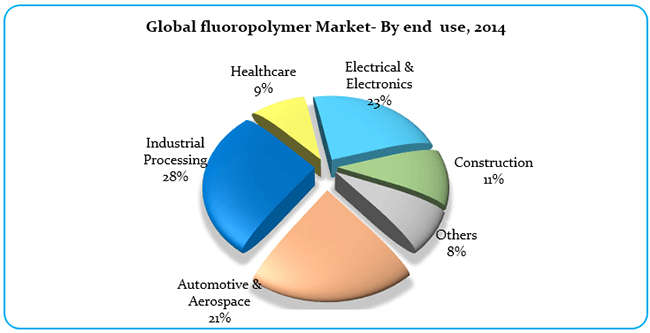
By end use industry, the global fluoropolymer market is segmented into automotive & aerospace, industrial processing, healthcare, electrical & electronics, construction and others. Industrial processing segment accounted for the largest market share of over 28% of the global value for fluoropolymers in 2014. With over 20% share in the global fluoropolymer market, the electrical & electronics was the second-largest end use industry in the global fluoropolymer market in 2014 and is anticipated to expand at a CAGR of 5.6%, in terms of value, during the forecast period.  Automotive & aerospace segment is projected to witness comparatively high CAGR of 5.7% over the forecast period. Fluoropolymers are largely used in industrial processing and electrical & electronics industries in various applications such as pump, impellers, coating for heat exchangers, tanks, reaction vessels, autoclaves, container, flue duct expansion joints, components for manufacture of semiconductors and electrical insulation. This is mainly owing to the excellent chemical resistant and mechanical properties offered by fluoropolymers. Furthermore, the scope of other end use industries segment for fluoropolymers is expected to expand in the near future due to increasing usage of fluoropolymers in emerging applications such as waterproof clothing, non-stick cookware and dental filling.
On the basis of product type and end use industry, the report analyses the attractiveness of each product type and end use industry using the attractiveness tool. Furthermore, all the end use industries and product types of fluoropolymer are analysed in terms of Basis Point Share to understand individual segments relative contribution to overall market growth. This detailed level of information is important for identification of various key trends of the global fluoropolymer market.
All the above sections evaluate the present scenario and growth prospects of the global fluoropolymer market for the period 2015–2025. 
Fluoropolymer Market Value

Hosting Infrastructure Services Market Emerging Opportunities, Growing Demand and Significant Trends by 2029

ICT.JPG
The global hosting infrastructure services market is estimated to reach a value of US$ 12 billion in 2019, up from US$ 11 billion in 2018, according to a recently published report by Future Market Insights (FMI). Gains remain underpinned by a range of factors, including continuous advancements in cloud services and migration to hybrid IT environments.
Operational efficiency along with low cost and enhanced security are identified as key factors behind the spike in adoption of hosting infrastructure services. Furthermore, robust developments in small and midsize businesses (SMBs) are being captured by market vendors as dynamic opportunities to gain higher traction, opines the FMI report.
The emergence of highly advanced technologies such as machine learning (mL) and artificial intelligence (AI) has led to tectonic shifts in end-user preferences as well as services offered. End-users’ preference for a holistic, multi-pronged approach is influencing vendors to merge traditional hosting infrastructure with modern public- and private- cloud technologies.
A number of companies operating in the BFSI industry are embracing hybrid cloud models through which critical applications and processes are migrated to private cloud with advanced security attributes, while other applications are transferred to public cloud for agility and cost efficiency. These factors are likely to increase the appeal for businesses and enterprises to leverage hosting infrastructure service providers.
Big Gains in Managed Hosting and Colocation Services
Managed hosting and colocation services continue to witness greater adoption; collectively, these account for 2/5threvenue shares. As businesses make it a point to focus on their core competencies, rather than worrying about managing IT infrastructure, average spending is likely to witness a steady increase. According to the study, adoption is likely to remain strong in storage, data security, and cloud computing categories. The adoption of managed hosting and colocation services on the basis of ‘pay-per-use’ model has thus enabled the critical exchange and crossroads of entire IT environment.
It is also imperative to note that virtual private server-based services or VPS hosting servicesare growing in prominence. Providing enhanced control over servers and enabling agile deployment of virtualized workloads at low infrastructure cost, spending on VPS services is likely to witness an uptick over the course of the forecast period.
While industry-wide adoption of Software as a Service (SaaS) continues to influence growth strategies, stakeholders are focusing on boosting the visibility of other services such as Infrastructure as a Service (IaaS) and Platform as a Service (PaaS). As enterprises are increasingly incorporating IaaS in their hybrid IT environments, hosting infrastructure service providers are implementing latest tools and technologies to improve operational efficiency at competitive offering. According to the FMI report, hosting infrastructure revenues through the adoption of IaaS is estimated to register a year-over-year (Y-o-Y) growth of 8% in 2019 through 2018.
According to the report, vendors are focusing on offering novel services and highly standardized products through technological innovations. Small players are flourishing through the presence of data center in respective countries and specific offerings for local customers.
FMI’s research study offers a long-term perspective and extensive analysis into opportunities prevailing in the hosting infrastructure service market for the period between 2019 and 2029. According to the study, the global hosting infrastructure services market is estimated to record a CAGR of ~8% during the forecast period.

Pillow Cases Market Current Industry Size and Future Prospective with Key Players, Drivers and Trends

  In an upcoming market research study, Future Market Insights (FMI) brings to fore both macro- and microeconomic factors that will shape th...